Ethnic Facial Features: What Can Appearance Tell You?
A careful guide to ethnic facial features, appearance clues, delicate features, mixed heritage, and the limits of photo-based AI.

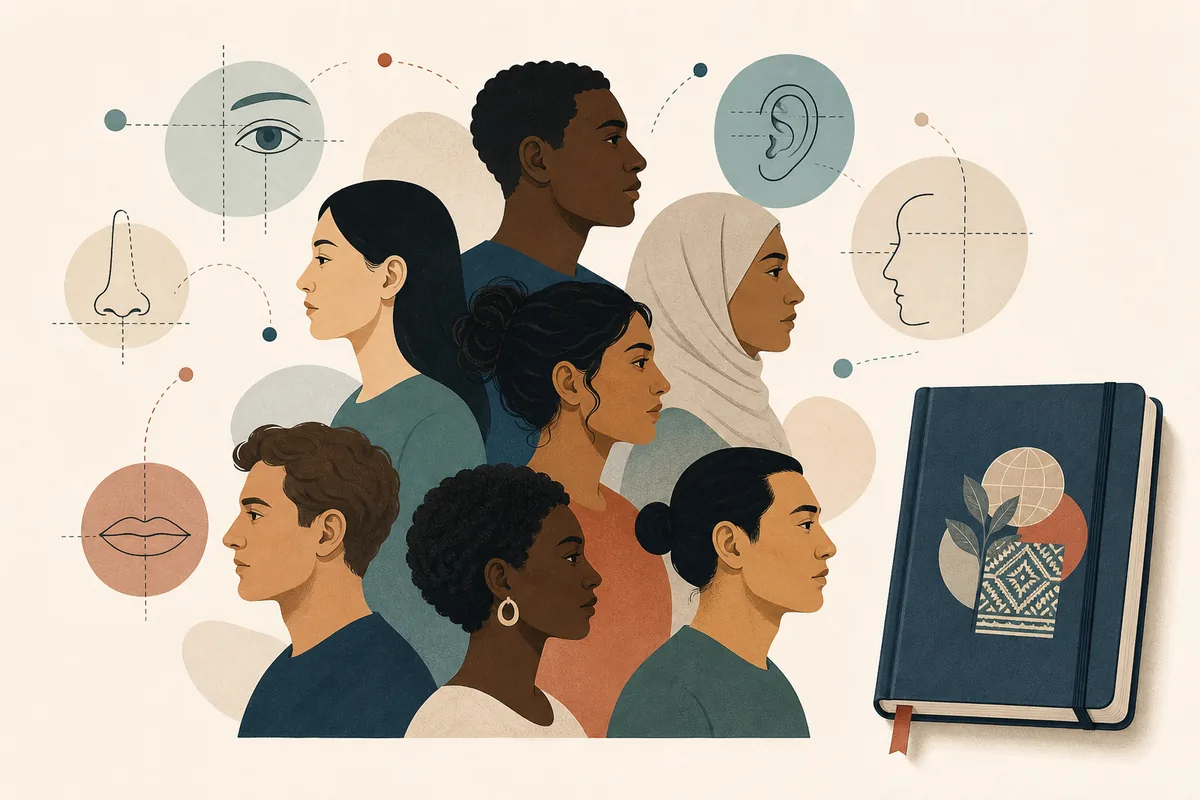
Table of Contents
- Quick Answer: Ethnic Facial Features Are Clues, Not Conclusions
- What Facial Features Can Suggest
- Which Ethnicity Has Delicate Facial Features?
- Why People From the Same Ethnicity Can Look Different
- The Evidence Layers: Photo, Records, DNA, and Identity
- How AI Photo Tools Should Handle Ethnicity Facial Features
- How to Talk About Ethnic Features Respectfully
- FAQ
Ethnic facial features are often discussed as if every group had one fixed face. Real people do not fit a single template. Face shape, eyes, nose, lips, cheekbones, skin tone, hair and proportions can influence visual impressions, but the same traits appear across many populations and cannot verify ethnicity.
This guide explains what visible features can and cannot suggest. It also answers the sensitive long-tail question, which ethnicity has delicate facial features, without ranking groups or turning stereotypes into facts. The safer answer is that delicate features are an aesthetic description, not an ethnicity.
Quick Answer: Ethnic Facial Features Are Clues, Not Conclusions
Facial features can shape how someone is perceived, but they are clues about appearance, not proof of ethnicity. Use family history, cultural context, self-identification and appropriate records for identity questions; use a photo tool only as a clearly limited visual estimate.
That means appearance can support a broad guess like this photo resembles Mediterranean, East Asian, West African, Northern European, Indigenous American, or mixed heritage patterns. It cannot prove that someone is those things. Ethnicity also includes culture, language, family history, community, migration, religion, and self-identification.
Key Takeaway
Use facial features as soft visual clues. Use family records, cultural context, DNA when appropriate, and self-identification for real ethnicity questions.
What Facial Features Can Suggest
A responsible discussion focuses on probability and context. A single feature means very little; a pattern of several visible traits may suggest how a person is commonly perceived in a photo. Even then, the result is about resemblance, not proof.
The table below separates useful visual observations from overconfident identity claims.
| Visual observation | What it may suggest | What it cannot prove |
|---|---|---|
| Face shape and cheekbone structure | A broad resemblance pattern in one image | Specific ethnicity or ancestry |
| Eye area, eyelid shape, and brow spacing | How the face may be perceived visually | Nationality, culture, or language |
| Nose bridge, lips, and jaw proportions | Family resemblance or population-level variation | Membership in a group |
| Skin tone and hair texture | Surface appearance that varies with lighting and styling | DNA percentage or identity |
| A combination of traits | A better appearance estimate than one trait alone | A final label for the person |
Which Ethnicity Has Delicate Facial Features?
The question ‘which ethnicity has delicate facial features?’ does not have a reliable or respectful one-group answer. Delicate or fine features can appear in people from many backgrounds. Describe the visible feature itself—soft contours, a narrow bridge, rounded cheeks or defined cheekbones—without assigning an ethnicity from a face alone.
Trying to assign delicate features to one ethnicity creates a false hierarchy. It also ignores individual variation. Two siblings can look very different. A person with mixed heritage may show one family line in the eyes and another in the face shape. A photo can highlight or hide traits depending on lens distance and light.
If you are asking because you want to describe your own face, use neutral wording: soft facial balance, fine features, gentle contours, narrow features, rounded features, or high contrast features. If you are asking about someone else, avoid turning a visual impression into a claim about their ethnicity.
Safer wording
Say what you observe in the photo instead of assigning a group: soft contours, fine nose bridge, balanced midface, rounded cheeks, defined cheekbones, or mixed resemblance.
Why People From the Same Ethnicity Can Look Different
Ethnicity is not a face template. Variation inside a group is often larger than people expect.
- Family variation. Traits recombine across generations, so siblings and cousins may inherit different visible patterns.
- Mixed ancestry. Many people have more than one ancestral line, and a photo may emphasize one side of the family.
- Environment and age. Sun exposure, age, health, hairstyle, facial hair, and body composition can change how features read.
- Camera effects. Lens distortion, selfie angle, lighting, filters, and expression can shift the apparent nose, jaw, eyes, and skin tone.
- Broad labels. Labels like Asian, Black, White, Latino, Arab, or South Asian contain many communities with different histories and appearances.
The Evidence Layers: Photo, Records, DNA, and Identity
A face photo answers the narrowest question: what does this image resemble? Family records answer where people, languages, and communities came from. DNA can suggest inherited ancestry regions, although it depends on reference panels and updates. Personal identity includes lived culture and self-understanding.
The strongest answer comes from matching the evidence source to the question. Use an AI photo estimate for appearance curiosity, not for deciding who you are. Use records and family context for heritage. Use DNA carefully when genetic ancestry is the actual question.
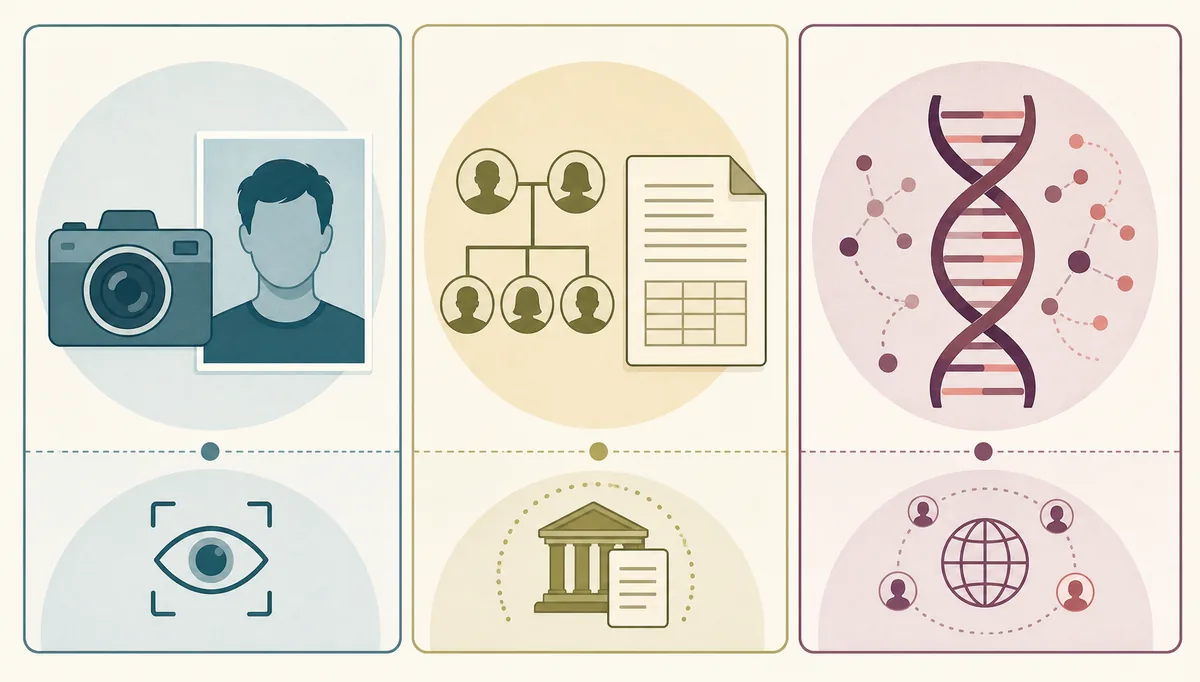
Appearance, family records, and DNA answer different questions. None of them alone contains the full identity story.
How AI Photo Tools Should Handle Ethnicity Facial Features
An AI photo tool may compare visible patterns and return a visual estimate, but the output is affected by lighting, angle, image quality, expression and the model's training data. A responsible result should explain uncertainty and never present appearance as ancestry or legal identity.
If you use a photo tool, upload a clear, natural image and read the output as resemblance. Do not use it to label strangers, judge belonging, or make decisions about employment, dating, medical care, immigration, or legal identity.
| Question | Photo tool fit | Better evidence |
|---|---|---|
| What ethnicity do I look like in this photo? | Useful for curiosity | Several clear photos plus context |
| What is my inherited ancestry? | Weak | DNA plus family records |
| What culture or community am I part of? | Not suitable | Self-identification and lived history |
| Why do I look mixed? | Can suggest visible resemblance | Family history, migration, and ancestry context |
How to Talk About Ethnic Features Respectfully
The phrase ethnic features can sound natural in search, but in conversation it can feel vague or othering. The safer approach is to describe visible traits without treating them as destiny.
Good language keeps uncertainty visible and leaves room for self-identification. Instead of saying you look like a specific ethnicity, say the photo gives a resemblance or that certain features are often perceived a certain way.
- Describe, then qualify. Use phrases like appears, resembles, may be perceived as, or in this photo.
- Avoid ranking groups. Do not say one ethnicity is more delicate, more attractive, or more authentic than another.
- Separate face from identity. A person decides their identity; a viewer only sees an image.
- Use tools on yourself first. Avoid uploading or judging other people's photos without consent.
FAQ
A Face Can Start a Question, Not Finish It
Ethnic facial features are best treated as appearance clues. They can help explain why a photo may be perceived in one way, but they cannot decide heritage, identity, or belonging.
If your curiosity is visual, an AI photo tool can be interesting. If your question is personal, combine the photo with family records, community context, DNA when relevant, and your own self-identification.
References
- National Human Genome Research Institute: phenotype means observable traits shaped by genes and environment. View Source
- U.S. Census Bureau: race and ethnicity categories are reporting categories, not complete personal identity. View Source
- NIST FRVT demographic effects report: face-analysis systems can behave differently across demographic groups. View Source
About the Author
Sophie Laurent
Sophie Laurent writes about identity, ancestry, family history, and the practical limits of AI tools. Her work helps readers separate curiosity, appearance, records, and genetic evidence when exploring ethnicity or heritage.
Last updated: Updated August 13, 2026